
Football, Explained: Why Are Wingers Playing on the ‘Wrong’ Side?
Ever wondered why left-footed wingers are played on the right, and vice-versa? Dragon Football has the answer.
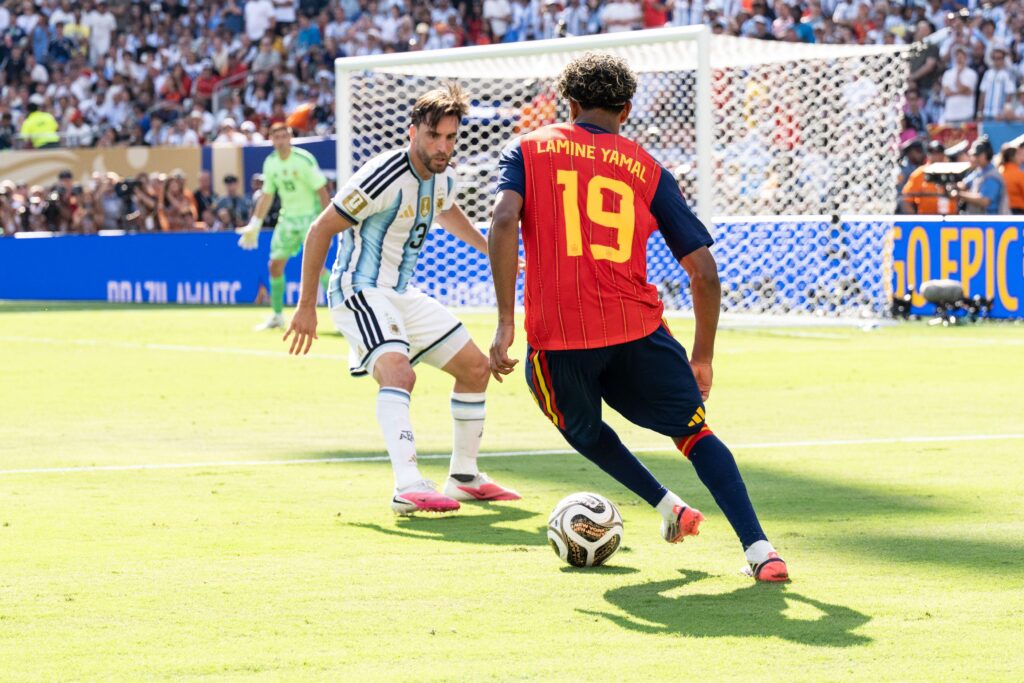
There was a time when football’s wide players followed a rule so obvious that nobody thought to question it.
If you were left-footed, you played on the left. If you were right-footed, you played on the right. Your job was to beat the full-back, reach the byline and swing crosses into the penalty area. Stay wide, stretch the pitch, deliver the ball.
Now switch on almost any elite match and that logic has been turned on its head.
Mohamed Salah starts on the right despite being left-footed. Bukayo Saka does the same. Lamine Yamal has followed the same path at Barcelona.
On the opposite flank, Vinicius Junior, Rafael Leao and Khvicha Kvaratskhelia attack primarily from the left while favouring their right foot. The “wrong-sided” winger has become so commonplace that the traditional winger now feels like the novelty.
How did football get here?
The answer begins with the slow evolution of the winger’s role. For much of the twentieth century, wide players existed primarily to create chances for somebody else.
Stanley Matthews, for example, became one of England’s greatest footballers in the 1930s, 40s and 50s by repeatedly beating his full-back, reaching the byline and crossing. Goals were the striker’s responsibility.
The tactical landscape shifted as back fours became increasingly dominant and teams defended in more compact, organised units. Space down the outside became harder to find. Coaches wanted their wide midfielders to defend, combine with central players and attack the spaces between defenders rather than simply hugging the touchline.
Even then, there were signs of the future. Chris Waddle, naturally left-footed, became one of Europe’s finest right wingers.
Tom Finney was versatile enough to excel on either flank. Arsene Wenger also nudged the game in a new direction with Arsenal. Marc Overmars and later Robert Pires flourished from the left despite favouring their right foot, creating a greater goalscoring threat while Ashley Cole provided overlapping width.
They remained exceptions, but they demonstrated how dangerous it could be to receive the ball on your stronger foot while driving toward goal.
Then everything accelerated during the late 2000s.
A new era of wingers

Lionel Messi had already established himself as a left-footed attacker starting from the right, but Pep Guardiola pushed the concept even further. After initially continuing to use Messi from the right, Guardiola’s famous decision to move him into a false nine role in 2009 transformed both Barcelona’s attack and modern tactical thinking.
At the same time, Arjen Robben perfected perhaps the most recognisable move in football. Every defender knew he wanted to cut inside from the right onto his left foot. Almost nobody could stop him.
Neither player invented the inverted winger, but together they helped make it the blueprint for elite attacking football. By the middle of the 2010s, the balance had tipped. Across Europe’s biggest leagues, left-footed right wingers and right-footed left wingers had become the norm rather than the exception.
The appeal is straightforward. A winger receiving on their stronger foot immediately becomes a shooting threat instead of simply a crossing threat. Rather than delivering hopeful balls into crowded penalty areas, they can attack the gap between full-back and centre-back, combine with midfielders and create higher-quality chances.
Performance analysis later put numbers behind something coaches had already begun to recognise: attacks ending with central shots generally proved more productive than attacks that relied primarily on crosses.
Their movement also changed the role of the full-back.
If the winger drifted inside, somebody still had to provide width. Ashley Cole repeatedly overlapped Pires at Arsenal. Dani Alves surged beyond Messi at Barcelona. Andrew Robertson stretched Liverpool’s left flank while Sadio Mane attacked central spaces. One player narrowed the pitch, the other stretched it.
Modern coaches have adapted that principle in different ways. Some still rely on overlapping full-backs. Others ask full-backs to move into midfield while wingers stay wide until the right moment to drive inside. Whatever the system, the objective remains similar: occupy the outside lane, overload central areas and force defenders into difficult decisions.
Traditional same-sided wingers have not disappeared entirely, although they are less common at the highest level. Coaches still use them when they want early crosses, outside runs or direct attacks towards the byline.

More often, however, the distinction is blurred. An inverted winger can stay wide, beat a defender on the outside and cross without ceasing to be wrong-sided. The starting position matters more than the route taken once the ball arrives.
Perhaps that explains why the role has endured.
The old winger existed to create for the centre-forward. The modern winger is expected to score as well as supply, whether that is Salah curling into the far corner, Saka attacking the inside channel or Yamal gliding onto his left foot.
Football did not suddenly decide that left footers belonged on the right or right footers on the left. It gradually discovered that the most dangerous route to goal often begins by moving away from the touchline rather than towards it.
The winger may start on the “wrong” side, but for modern football, it has proved to be exactly the right place.