
Phoenix Clubs: The Fall and Rebirth of AFC Wimbledon
AFC Wimbledon's story is one of the most remarkable tales in football. Discover their rise from the ashes and rebirth, told from the heart of the club.
The phone call came the night before, which somehow made it worse.
For more than a year, Wimbledon supporters had thrown themselves into a campaign to stop their football club leaving South London. They had lobbied politicians, organised demonstrations, argued their case in the media and exhausted every avenue they could think of.
Even as rumours swirled and hope began to fray, most still believed somebody, somewhere, would come to their senses. Football clubs were not meant to be moved like furniture. Not seventy miles up the road. Not away from the people who had built them.
But on 28 May 2002, the three-man independent commission appointed by the Football Association approved Wimbledon FC’s relocation to Milton Keynes. Long before the decision was announced publicly, Ivor Heller already knew.
A well-placed source had told him the previous evening that the fight had been lost. He called the other three men who would become synonymous with the rebirth of Wimbledon football: Kris Stewart, Marc Jones and Trevor Williams.
By the following morning, Heller had reached a conclusion that still surprises him with its simplicity.
“I wasn’t going to spend my time lamenting what we’d lost,” he says. “We’d start again.”
The remarkable thing is that none of them spent much time debating it. There was no grand meeting, no philosophical discussion about phoenix clubs or supporter ownership. The four men had all arrived independently at the same point. If Wimbledon had been taken away, they would build another one.
“When everybody agreed that was the right thing to do,” Heller recalls, “we got started immediately. And as soon as we got started, I just knew it was going to happen.”
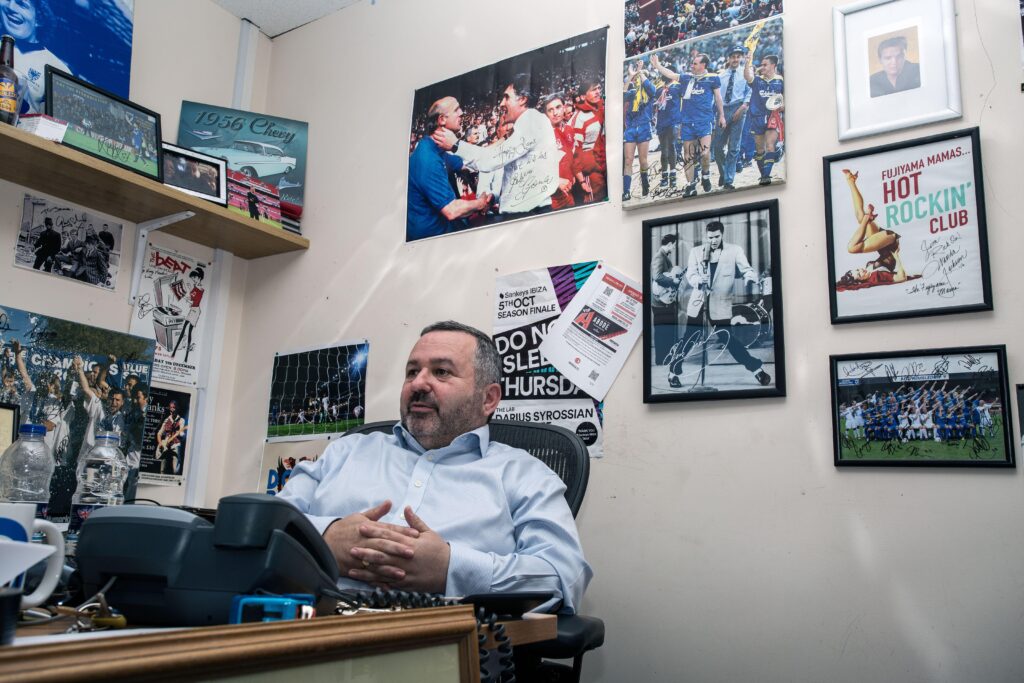
That confidence was not based on some grand ambition. Heller’s vision was wonderfully modest. He wanted to watch a team called Wimbledon, playing somewhere close to Wimbledon, wearing blue and yellow and kicking a football around. In those first hours, the dream stretched no further than that.
Stewart remembers arriving at the same conclusion from a slightly different direction. Throughout the campaign to save Wimbledon, there had always been dark moments when supporters would acknowledge the possibility that they might have to begin again. It was an idea that surfaced at the end of difficult evenings, usually accompanied by tired shrugs and gallows humour. Nobody really believed it because everyone was still focused on stopping the move.
“Until it becomes real, it’s easy to say,” Stewart says. “You’re still trying to win.”
He had travelled to Soho Square on the day of the decision, joining supporters outside the Football Association headquarters. There was no ceremony and precious little explanation. The commission’s verdict arrived in the form of a statement many supporters found cold and dismissive. Exhausted after months of campaigning, people drifted back towards Wimbledon carrying the peculiar emptiness that follows a fight you thought you might still win.
Then came Marc Jones.
Stewart still laughs about it now. Jones was moving through the crowd grabbing people, almost physically shaking them into life.
“Come on,” he kept saying. “This is it. We said we’d start again. We’re going again, aren’t we?”
Suddenly the idea stopped being theoretical. It stopped being something supporters said to each other to lift morale. It became a responsibility.
“It wasn’t just some wild thought at the end of a terrible day,” Stewart says. “There was a belief. We actually had to do it.”
Wimbledon’s rise from the ashes
For both men, what happened next has often been misunderstood. There remains a tendency to portray AFC Wimbledon as a protest club born from bitterness. They reject that description.
Stewart, in particular, sees things differently.
“We’d had the fight,” he says. “We’d done everything we could. We’d worked so hard together and we lost. I didn’t want all of that to turn into despair and anger. I just wanted to watch football again.
“Football’s supposed to be enjoyable. You’re supposed to go with your mates and have a laugh. We’d forgotten that.”
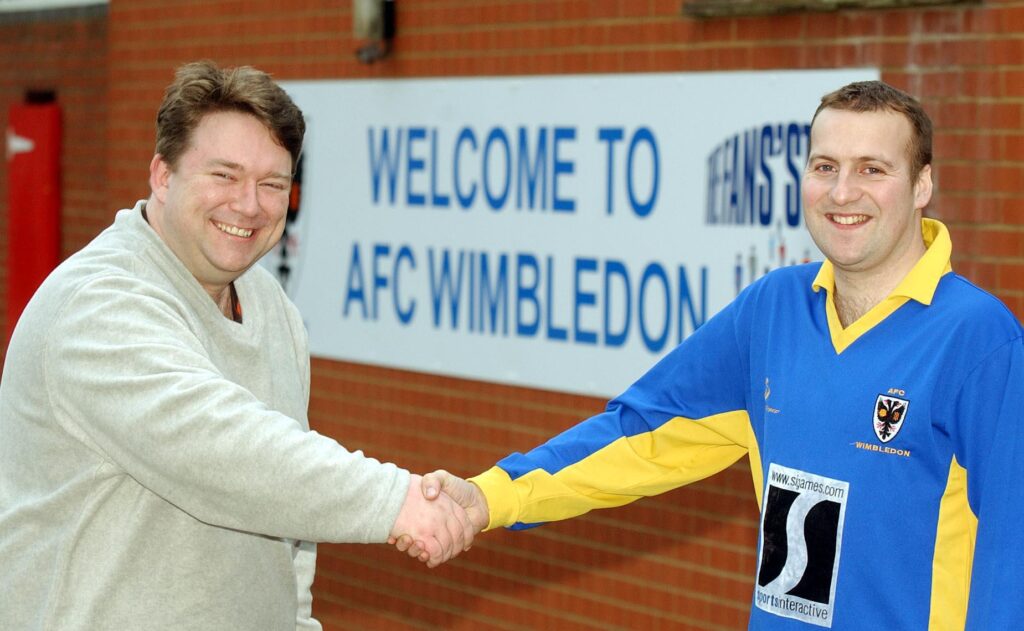
Within hours of the commission’s verdict, practical problems were replacing emotional ones. Heller became obsessed with one thing above all others. There could be no gap.
He worried that if supporters were left without a team for a season, people would drift elsewhere. South London offered plenty of alternatives. Sutton United, Tooting & Mitcham, Carshalton Athletic. Supporting a football club is a habit, and habits, once broken, are difficult to restore.
They learned they had just twelve working days to secure senior status. To achieve that, the new club needed a legally binding three-year groundshare agreement. For most clubs, such negotiations take months.
They had days.
“It looked daunting,” Heller says. “And it turned out to be daunting.”
Yet somehow everything aligned. Kingstonian agreed to share Kingsmeadow. The administrative hurdles were cleared. Problems that should have taken months were solved in weeks.
Sleep became an optional extra.
“There wasn’t much of it,” Heller laughs.
Public meetings had to be organised. Money needed raising. The supporters had to be convinced that this wasn’t simply an emotional reaction but a credible football club. The founders knew they needed to project competence. Without that, the movement would dissolve into nostalgia.
Instead, something remarkable happened.
“The meetings were electric,” Heller says.
The atmosphere surprised even the people standing at the front. Hundreds packed into halls not because they wanted somebody to save them, but because they wanted to save themselves. Volunteers emerged from every corner of the Wimbledon community. People offered skills, money and time. Some became turnstile operators. Others became stewards. Working groups sprang up to tackle every conceivable problem.
Stewart believes much of that energy had been built during the previous year. The campaign against relocation had drawn supporters closer together and brought them into contact with schools, local charities and Merton Council. Relationships had been formed that suddenly proved invaluable.
“We’d done all this work already,” he says. “There was a lot of goodwill.”
And then there was the sentence.
Buried inside the independent commission’s report was a line that Heller still remembers word for word. It stated that the creation of “a Wimbledon Town-type football club” would “not be in the wider interests of football”.
The phrase irritated him then and amuses him now.
Years later, the company that owns AFC Wimbledon’s stadium was christened Wider Interests Limited.
Football supporters have long memories.
As the club began taking shape, another principle emerged. They wanted Wimbledon to remain Wimbledon. Not merely in colours or in name, but in spirit. The old club had always prided itself on being the outsider, the underdog that refused to accept its allotted place. Stewart wanted that mentality to survive.
At the same time, the experience of losing their club had convinced them that ownership mattered.
“It couldn’t become someone else’s toy,” he says.
Supporter ownership was not some abstract political idea. It was a practical response to what had happened. If AFC Wimbledon belonged to its supporters, then nobody could uproot it on a whim.
Heller remembers early meetings where supporters debated replica shirts. Adults agreed to pay premium prices to help the club generate income. Children’s shirts were deliberately sold with almost no profit because they wanted youngsters wearing Wimbledon colours. Fans voted on kit designs. Home and away strips remained unchanged for two seasons.
“We really were all in it together,” he says.
That spirit carried the club through its astonishing rise. Crowds of thousands arrived in the Combined Counties League. Sandhurst Town, used to gates of around 75, suddenly found themselves welcoming almost 2,000 travelling supporters. Promotions followed. By 2011, AFC Wimbledon had climbed into the Football League, just nine years after being founded in the office of Heller’s print company.
People kept telling them it couldn’t be done. They said supporters couldn’t run football clubs. They said supporter-owned clubs would never reach the League. Then they said Wimbledon would never return to Merton.
That final dream mattered most.
The ultimate homecoming

By the late 2000s, returning home had become the defining ambition. Many thought it unrealistic. Kingsmeadow was functioning well. A new stadium in south-west London seemed financially absurd, particularly given the cost of land. Yet the same scepticism had greeted almost every previous milestone.
When planning permission for a new stadium at Plough Lane was finally granted in 2015, Heller’s fist-pump reaction resembled a cup final winner.
“It ticked every box,” he says. “Everything we’d ever said we wanted to do.”
The stadium eventually opened in 2020, just a few hundred yards from the old Plough Lane. To outsiders, it represented a remarkable achievement. To those who had started the club, it completed a circle.
For Heller, that moment was proof that all the dismissive voices had been wrong.
“People said we were mad,” he says. “They said we’d never do this and we’d never do that. Well, look at us now.”
The journey changed both men in ways neither expected.
Stewart spent four and a half years working full-time for the club. Holidays became opportunities to answer emails. Birthdays involved taking phone calls outside restaurants. Conversations with old friends became awkward because he had little else to talk about.
“There wasn’t an off switch,” he says.
He laughs about strangers recognising him in supermarkets and parks, much to the bewilderment of his family. Yet he admits the experience changed relationships. He was no longer just another supporter standing on the terraces. He was helping to run the football club.
Looking back, he thinks he probably stayed six months too long. But not once did he regret doing it.
“I’ve never thought I wish I’d ducked it,” he says.
Heller feels the same, though he would offer some advice to the younger version of himself sitting on that awful evening in May 2002.
Take better care of yourself. Take better care of your family. And write everything down. Because memories fade.
That, perhaps, is what bothers him most when people discuss AFC Wimbledon today. He worries that some have forgotten what actually happened. Forgotten the pain and the anger. Forgotten why a group of supporters ended up creating a football club in the first place.
“Our football club was stolen from us,” he says.
He stresses that he speaks only for himself. Yet he remains convinced that AFC Wimbledon is not a replacement for Wimbledon FC. In his eyes, it is Wimbledon FC. Continuing. Surviving.
If he had not believed that, he says, he would have stayed in business and got on with his life.
Instead, four men sat in a print office in south London with nothing but grief, stubbornness and a refusal to disappear.
Twenty-four years later, there is a stadium back at Plough Lane, league football, thousands of supporters and a club owned by the people who rebuilt it.
Football clubs are often described as institutions. Buildings. Companies. Assets. But those four men learned something on the worst day in Wimbledon’s history. A football club is a living, breathing thing. And a football club lives wherever enough people refuse to let it die.